
Links 07.2026

On a Personal Note
Not much happened this week, so I have no clever Sunday thought for you. Luckily, this is a fully packed edition of Links. Enjoy!
(Some big news coming in the next weeks though, inshallah!)
Meanwhile, I think this whole #sinofuturism thing is becoming way too real, people. These days, I wake up and immediately drink hot water, I’m about to learn which kind of tea I should boil with goji berries and apples in the evening, and my For You Page is full of Chinese baddies giving me life advice. It’s happening…
(Yes, this wikpedia page exists)

Listless Liberalism
Hmmm, I wasn’t sure whether I should include this article in the newsletter. Because it is, once again, like so many pieces about the demise of liberalism, descriptive rather than prescriptive. But it makes an important point. Plus, the author convinced me with this banger of a description of the non-aesthetics of liberalism:
Among the marquee mannerisms of recent liberalism we find chains selling salad bowls , mixed-use developments featuring glassy apartment complexes, the television show Parks and Recreation, the grocery store Trader Joe’s, the word “nuance,” glasses with rectangular frames, group-fitness classes, the profession of consulting, news startups focusing not on criticism or reporting but on commentary, and nonfiction that is a little too good for an airport bookstore but a little too slick and credulously economics-heavy for a literary magazine. The smug yet unconvincing performance of non-aesthetics amounts to aesthetics too.
I mean, slop bowls, spinning classes and social running clubs, pretentious words, and Patagonia vests while reading Ezra Klein’s Abundance. That diagnosis is spot-on!
And the overall theme that liberalism lacks a vibe ain’t new to my readers. Liberalism is intellectually and culturally killed by its own technocratic vanilla crowd. We don’t really think anymore, and we could never meme anyway. So, that is that.
At least, she offers two scathing reviews of the aforementioned (I’m a liberal, I use such words) Abundance and Cass Sunstein’s liberal slop (s/o to Alex Schwitteck). BTW, easy money hack: Never buy a Sunstein book.
Unsurprisingly for a literary critic, she offers analysis; not solutions. Although her observation about TED talks vs podcasts made me chuckle. But do not worry. This newsletter has you covered. Over the past 7+years, we have accumulated quite a few cultural markers for a proper liberal aesthetic. Maybe it is time for a starter kit for the latecomers.
Anyways, read the whole thing.
(Fun fact: This is from her website: “Before the pandemic, I followed Hegel in regarding nature as geistlos, but now, like any good Heideggerian, I am a big fan of hiking.” This sentence could be sth straight from this newsletter ngl)
Every politics has its characteristic aesthetics. This is a truism so widely accepted in the case of fascism that it often tempts otherwise discerning critics to overstate the power of reactionary art. For every Leni Riefenstahl or Knut Hamsun, there is some long-forgotten purveyor of the most banal kitsch—some minor painter of gingerbready village scenes, some carver of half-timbered confections (to say nothing of the nameless mediocrity who directed the alpine romance flicks in which Riefenstahl starred before she took up directing). Still, the frisson that fascism’s best artifacts afford has one merit: it reminds us that fascism looked and felt like something, that it was an ideology with an accompanying sensibility.
The same is rarely said of liberalism, a political formation so pointedly unostentatious that we tend to gaze right through it. There are reams of writing about fascist military parades and socialist-realist murals, yet there is almost nothing comparable about the dull tint at the end of history. Where is liberalism’s “Fascinating Fascism”? Who is its Riefenstahl? At least in its most recent incarnation, it tends to disdain these questions. In its dreams of itself, it is unadorned—a skeletal set of principles and policies without any attendant body. Its heroes are too busy scanning polls and skimming white papers to bother with self-fashioning: in the quintessentially liberal TV series The West Wing, harried wonks pace the halls of the White House in ill-fitting suits and sensible shoes, trying to appear as if they eschewed the distractions of appearance altogether.
[…]
Conservatism, which does not hesitate to impose a single vision on its adherents, is much easier to advertise—and aestheticize. The highly romanticized pictures it recommends are often unappealing, but they are undeniably concrete. Even people who do not want to live in the rosily sanitized universe of a Norman Rockwell painting or a Thomas Kinkade streetscape know exactly what one would look like. A Rawlsian, in contrast, cannot say in advance exactly how any given instance of liberalism will unfold. Though her system has stringent principles—among them, a presumption in favor of material equality—they are consistent with a panoply of cultural formations and styles of life. Justice can look like a small town in New Hampshire, but it can also look like downtown Manhattan. Many different social constellations are consistent with the principles of formal and material equality that the Rawlsian espouses. The plenitude is precisely the point.
[…]
The year The West Wing ended, 2006, it was supplanted by what would become perhaps the quintessential liberal genre: the online TED Talk, in which experts on a brightly lit stage pontificate to an admiring audience off camera. The TED Talk both reflected and modeled the technocratic ideal that triumphed alongside it; in 2016, Wired declared, “We Are Now At Peak TED.” Accordingly, the form has fallen out of favor as the politics of expertise have floundered. Establishment liberals struggle to adapt to the ascendant genre, the podcast, because it is the opposite of the TED Talk: democratized where the TED Talk is asymmetrical, informal where the TED Talk is staged, conversational where the TED Talk is monologic. There is no liberal Joe Rogan because his liberal equivalent would rather soliloquize and tweak a couple of ordinances than enter into an unscripted tête-à-tête for hours.
The Dark Enlightenment and the Return of Political Theology in Russia and the United States
Okay, this feels uncanny. I have covered Thiel, Dugin, et al here since the beginning of this newsletter. And while I knew there were considerable efforts to connect illiberal(≠ post-liberal) forces in Moscow and DC, I thought this was mainly about Dugin and Bannon (Benjamin Teitelbaum has talked about this). However, it seems that Thiel, after all, has the most reach. We were so early, y’all!
I hesitated a bit before sharing the article—as I find it philosophically rather shallow. There seems to be only a rather superficial understanding of the core pillars (it’s more than just Strauss and Schmitt) or of the different strands of the Dark Enlightenment (in my books, that category covers not only NRx but also /acc and HHH libertarianism, and some more kooky stuff). But readers of this newsletter are well aware of these movements anyway. If not, you can always listen to Weltanschauung #13 where we (at least partly) cover this.
BTW, if you want a good laugh, check out this Russia 2050 pamphlet. It is everything (and beyond) of the classic Dugin-style madness: Third Rome combined with de-urbanization lmao, a total fertility rate of 3.0 (Russia is currently at 1.3 or so), societal punishment for childlessness, gender-segregated schools, a Digital Ruble (Bitcoin Bros defending Russia in shambles!), a state-run economy (incl. space exploration ofc) and central bank, imperial reach from the former USSR to the Middle East and Africa, and ofc my favorite: the “Russian Ark” that would bring “импатрианты” (meaning: Westerners seeking refuge from ultra-liberalism) to the safe haven of Russia. Estimated number of such people: 10 f*cking million people. C’mon, bro! hahaha
(I probably should do a whole separate post on this document)
Peter Thiel’s project, where techno-optimism is combined with the idea of the Katechon—the force that holds back the coming of the Antichrist—provides a conceptual foundation for a potential alliance between American and Russian illiberal forces. The concept of the Katechon plays a central role in Thiel’s analysis of AI technology, as that which is capable of restraining the Antichrist may also, paradoxically, hasten his arrival.
In Russia, the concept of the Katechon was introduced into political and cultural discourse in the mid-1990s by Alexander Dugin, who, like Peter Thiel, draws on this idea from Carl Schmitt. In a recent interview with Metametrica, Alexander Dugin revealed that representatives of Thiel had met with him before the COVID-19 pandemic. According to Dugin, they discussed Thiel’s interest in the ideas of the Conservative Revolution, Eurasianism, and that Thiel had read Dugin’s Foundations of Geopolitics. A meeting between Thiel and Dugin in Moscow was reportedly in the works.
Thiel—and specifically his article The End of the Future (2011)—is cited in a new programmatic document by the Tsargrad Institute, Russia’s leading conservative think tank:
«Over the past 60−70 years, no genuine scientific or technological breakthroughs have occurred. The first to draw attention to this was the leader of American right-wing technocrats, Peter Thiel. In his article The End of the Future, published back in 2011, he noted that ‘we are no longer moving faster.’»
This document was presented at the Forum of the Future 2050 in Moscow in June 2025.
[…]
This document presents a hybrid of Traditionalism and Futurism, where proposals for replacing migrant labor with robots and planning missions to Mars coexist with the doctrine of the Katechon, autocracy, and the sacralization of the head of state. It states:
«In the 21st century, Russia’s mission as the Restrainer (Katechon) is:
— to regulate the balance of strategic interests and to maintain international security and a just world order [SG: LMAO] based on adherence to universally recognized principles of international law;
— to uphold global security and prevent humanity from descending into global war, chaos, and unrest;
— to defend Christianity and Orthodoxy, as well as traditional institutions and values—religion, family, classical culture, and so forth.”
The Forum of the Future 2050 is the first high-profile media event to highlight the shared goals of Russian and Western Tech-Right.
What is Populism Good for?
More evidence that the ultimate NPC take, i.e. that populism is “just about rhetorics”, is still stuck in 2016.
Sure, we can debate whether populism is a thin or thick ideology; but it is clearly a value-based framework. What populist-style rhetoric is actually good at is mobilization rather than persuasion. It creates urgency and a sense that something important is on the line. That is what brings people out to vote.
Which also means liberals can borrow from some of these “dark arts.” Obv, there is nothing worse than getting voters to the booth with a “happy clappy, everything is fine” message. (Ironically, demobilization and depoliticization was always the Merkel strategy. In a way, the pre-populist Machiavellian playbook.)
BTW, the then-opposition, now government, in Poland understood this very well. By banking on highly contested issues (such as abortion, etc.), they boosted turnout in the crucial 2023 election to a stunning 74.4 percent—the highest since the fall of communism, I think.
In other words, we need more of that sweet Dark Liberal re-politicization stuff.
Abstract
In recent decades, populist parties and candidates have gained increasing electoral support across the world. Despite this evident electoral success of populists, however, recent experimental studies find limited effects of populist rhetoric alone on vote choice. If such rhetoric is not effective in shaping voting preference, why would politicians adopt it, and what might explain the electoral success of populist candidates and parties? We argue that populism might influence elections through increasing turnout instead of or in addition to changing voters’ preference for candidates. However, existing conjoint and vignette survey experiments generally focus on forced candidate choice, which assumes full mobilization, potentially biasing the between-candidate choice estimates and missing abstention decisions important in real-world politics. To address this, we conducted a large-scale U.S. conjoint experiment of campaign messaging with an explicit abstention option to test for the possible mobilization effects of populism independent of persuasion effects and the various associated policy positions. Our results show that while populist rhetoric has limited persuasive impact, it can slightly increase mobilization, especially among voters who already hold populist views. Overall, however, voters’ alignment with candidates’ policy positions matters far more for both vote choice and turnout than the use of populist messaging itself.
US government to fund Maga-aligned think-tanks and charities in Europe
Surprise, surprise! All those delulu useful idiots who thought the Trump administration would now pour less money into the NGO complex might once again have misread the Orange Man. They never had any interest in making the Leviathan smaller; they wanted to make the Leviathan theirs. So now they just allocate funds from the big machine to finance their own stuff—domestically and internationally.
Luckily, the Muricans still do not (yet) understand that we don’t like them over here anymore. Soft power is fickle b*tch…
The 4D chess move seems to be backing Reform, RN, AfD & Co so that they all lose their respective elections lmao. Also: Romania get your sh*t together!

The Trump administration has sought to drastically scale back US foreign assistance and cuts have fallen heavily on programmes to support good governance, human rights and democracy. [Yet,] the US state department is set to fund Maga-aligned think-tanks and charities across Europe to disseminate Washington’s policy positions and challenge perceived threats to free speech. Senior state department official Sarah Rogers travelled to Europe in December to meet influential rightwing think-tanks and has spoken to key figures in Nigel Farage’s populist Reform UK party about deploying a pot of money to spread American values.
[…]
“The US administration is on a crusade to save Europe,” said one senior Reform UK figure who spoke with Rogers about the plans. “They have a real soft spot for the UK but feel it is under threat from dark forces that are spreading across Europe.” […] Another senior Reform figure said they had been told that Rogers “had a state department slush fund to get Maga-style things going in various places”, adding that she was keen to “fund European organisations to undermine government policies”.
[…]
A US official said the programme was a twist on previous state department projects that channelled funding towards specific causes overseas and was likely to focus on initiatives based in London, Paris, Berlin and Brussels.
The One Role Gen Z Women Still Want Men to Play
There has been a lot of chatter about the “politicization” of dating. So it is worth tracking the evolution of mating norms across generations. And indeed, there seems to be an effect that liberal females put more weight on the worldview of their partners.
Of course, the right will fabricate a story out of this like “Something Something: The Iliberalism of Liberalism, Exposed” or sth like that. You get what I mean. They get off on the thought that the alleged ideology of tolerance ultimately collapses into intolerance itself. However, to me, this has always been some sort of a category error.
Liberalism rests on value pluralism. That is kinda its point, because only liberty as an overarching guiding value allows for plural social arrangements. “Conservative” men, by contrast, are often not conservative in a coherent ideological sense (i.e., like Burke or Scruton or just traditional Christianity or so); but rather track a Nietzschean disposition. Those self-proclaimed “conservative” men are (more often than not) nothing else than nihilists who ultimately subvert hierarchies to power. Obviously, that does not pass the sniff test of “having values.” :P
And so the mismatch is not between values but between values and nihilism.
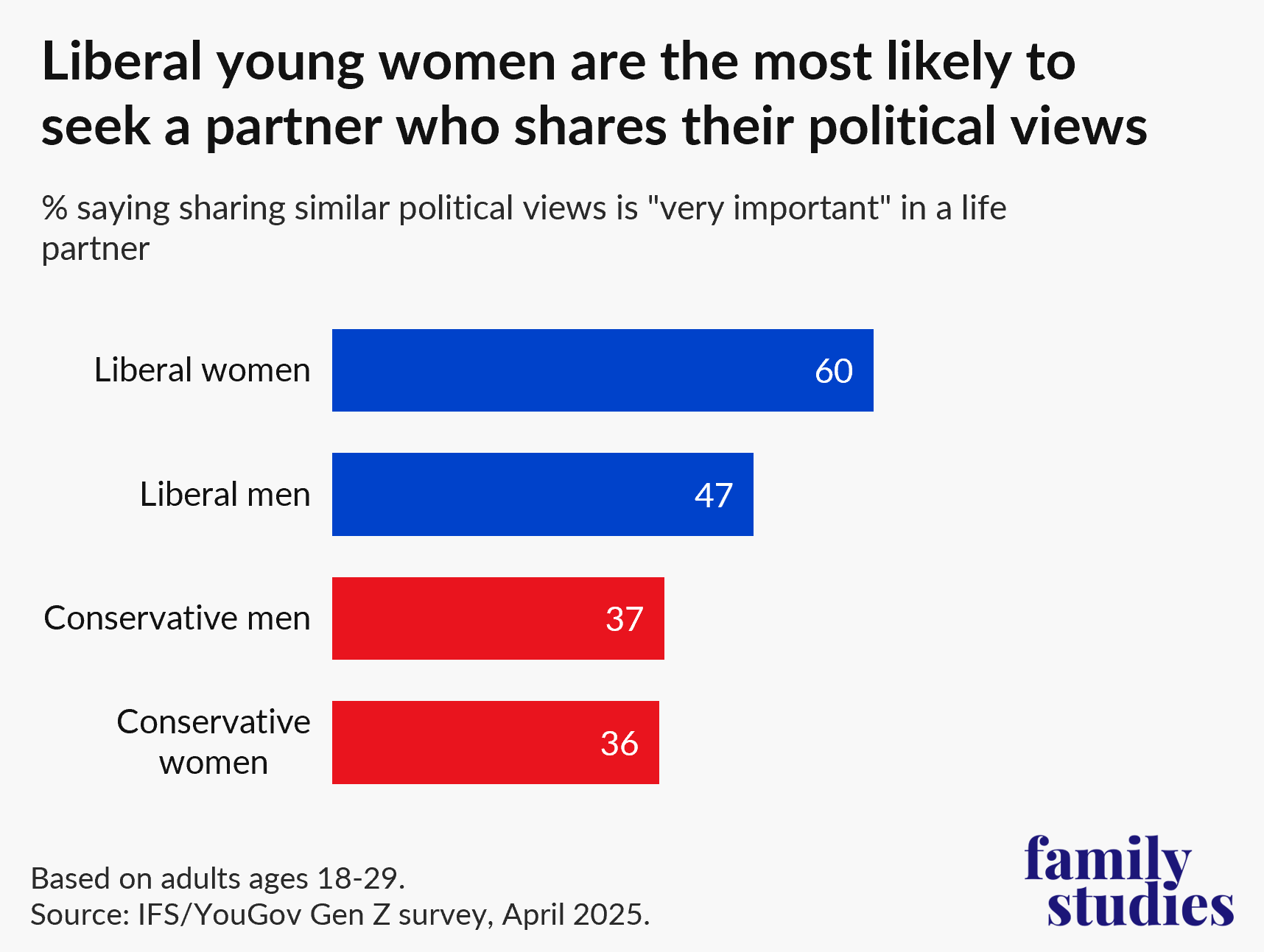
Damn, now I've been sidetracked by just one tiny chart in this article. However, there is much more in there. Lots of it is quite intuitive and not very surprising. Nevertheless, recommended.
(Some final dating advice: A stable job remains one of the best things to have if you want to succeed in the dating and mating economy. So, don’t become a Privatgelehrter like me)
[A] recent Pew analysis of data on 12th graders suggests that girls’ desire for marriage has declined significantly over the past 30 years, while boys’ interest has remained unchanged. For the first time since the 1970s, high-school girls are now less interested in marriage than boys.
[…]
First, a majority of young adults no longer expect men to lead in dating and to pay for dates. About 6 in 10 Gen Z men and women say that dating responsibilities, including paying for dates, should be shared equally, while about 40% say men should cover the bill. There are virtually no gender differences on this question.
Second, the traditional “men as breadwinner and women as caretaker” model is not what most of Gen Z believes. Instead, more than 80% of Gen Z women and 68% of Gen Z men say couples should divide work and home responsibilities in whatever way works best for them. Though young men are more likely than young women to say that it is better if men focus on breadwinning (32% vs. 18%), this view is still a minority position even among young men.
But traditional gender roles are not completely forsaken by the younger generation. More than 70% of young men say that men should protect women, and a similar share of young women agree. Only 26% of women say that “women don’t need protection from men.”
[…]
Previous research shows that men’s sense of being a protector is tied to healthier expressions of masculinity, better mental health, and greater family stability. And an earlier report […] finds that having a protective spouse is a one of strongest predictors of a happy marriage, especially for women.
Peace,
SG