
Links 09.2026

On a Personal Note
Hmmm, it’s hard to find a somewhat fitting opening line for the moment when the so-called “Board of Peace” just launched its first war.
Let me at least say thank you to everyone who reached out yesterday. I’m not in Erbil physically at the moment: but you’ll understand that I’m mentally there.
I don’t have much more to say tbh. The situation is still unfolding, and my confidence that Trump and/or Bibi know what they’re doing is fairly low. So yes, we might be in for more turbulence. (Imagine what will happen when US soldiers actually die). But who knows. Nothing ever happens.
Maybe we start with a bit of cynical laughter. All things considered, the world won’t be a worse place without Ali Khamenei around.

I was in the room last time Iran was hit. This is what I learnt
I’ve read a lot of coverage on Iran over the last 24 hours. Because obv, it’s another weekend of “monitoring the situation.” And I can confidently say this is the best piece out there.
It doesn’t make grand predictions. It doesn’t do stupid lip service to long-gone alliances. It doesn’t indulge in moralistic nonsense about the triumph of good over evil or freedom or whatever. Ben Judah (w/ whom I disagree on other things) understands the nuance of geopolitics.
Because (as we all know here) if you’re a black-and-white thinker on geopolitical issues, you’re a moron anyway. Geopolitics is about scenarios, likelihoods, random contingencies, and erratic personalities—and less about rules, institutions, and whatnot.
Anyway, I extracted many of the relevant passages. But read the whole thing. Many parts are actually incredibly revealing, for example, why the European mind struggles to comprehend Israel’s military might. (Plus, it is somewhat a vindication of my 2024 prediction that Israel will just re-order the Middle East).
Oh and btw, it makes blatantly obvious why you should never listen to ze Jermans (or ze French for that matter) regarding international affairs. Kant has damaged their brains.
Working for the foreign secretary, it became clear to me that a lot of what the British public believed was happening in the Middle East from their social media feeds was wrong. This was not Israel’s war in Gaza causing aftershocks. The 12-Day War was part of a great Middle Eastern war between Israel, Iran and its proxies that Hamas began on October 7. So too are the current strikes.
[…]
If there’s one thing I learnt about the headquarters of British diplomacy on King Charles Street, it is this: they are so traumatised by Britain’s military failures — Iraq, Afghanistan, Libya — and the Chilcot inquiry that they fail to see how the use of force could be successful for another state. In October 2024, the office looked befuddled as Israel successfully ripped up Hezbollah and their leadership. Watching Iran fire missiles back from its growing arsenal directly into Tel Aviv on the TV, I knew this wasn’t the end.
[…]
The next day we flew to Geneva for talks with the Iranians, together with the Europeans. There were hordes of cameras outside. But what I saw inside the room depressed me. The Iranian foreign minister seemed to be grandstanding and intransigent. What really got me down were the two other European foreign ministers: the German simply announced he didn’t believe America would ever strike Iran and that was that, while the Frenchman was building castles in the sky, believing there were still weeks or months left for the Europeans to lead a diplomatic solution.
Lammy [SG: former UK Foreign Secretary now Deputy Prime Minister] grew exasperated: the clock was ticking, he said, and the only way to stop US intervention was to talk to the US. This did at least seem to cut through to the Iranian, who — as the Europeans did extended press conferences — came to talk privately with the foreign secretary to hear more.
In fact, time had already run out. By the time we took off from Geneva, American B-2s were preparing for action. Twenty-six hours later they hit Fordow.
[…]
In January, with my boss Lammy no longer in the Foreign Office, I left government. Now out of it, I can see things more clearly. We have an America problem. […] The superpower we have based our entire security around has become profoundly erratic. I once saw secretary of state Rubio literally run out of a set piece meeting at Nato to take a call from Trump only to come back with an entirely different policy. White House staff don’t know what’s coming next.
We in Britain — as well as France and Germany — are not remotely ready for this moment either.
[…]
The public wants simple affirming answers about geopolitics, but geopolitics cannot provide that. Israel has committed great wrongs in Gaza but has been under a multi-front attack from an Iranian regime that is both seeking nuclear weapons and committed to its destruction. Iran has slaughtered tens of thousands of its own people amidst protests in recent weeks but a regime change operation could open the door to state collapse or something worse. A limited American-Israeli decapitation strike could force a deal but only avoid a spiral into a months-long all-out war if they find someone in the regime to work with — like Delcy Rodriguez in Venezuela — and come back to the table. Welcome to the real world.
What was true for so long, that Britain could be America’s best friend, fiercely anti-Kremlin and champion of international law, no longer stacks up. You have to choose or remain silent, if, like us, you are weak. This is what the collapse of the rules-based order looks like. And we are incredibly exposed.
Europe’s New Court Intellectual
There’s barely a conference where someone doesn’t ask me about Giuliano da Empoli’s The Hour of the Predator. And I must admit that, for a long time, I was blissfully ignorant of its relevance. But at one point, it became hard to ignore, especially when almost every week someone recommended it to me.
You’ll have to excuse me (and maybe this says more about me than I’d like), but I mostly read the Anglosphere rather than your average Suhrkamp release or French pseudo-intellectual pamphlet du jour. I hadn’t fully grasped how influential this book has been in Europe—despite having recommended his book about Surkov before. So, I ordered it and stumbled upon this scathing review.
I laughed out loud a couple of times. Great stuff. Obv, I don’t agree with the politics of the author; but his impulse seems certainly right. And sometimes you just want to read a review with a proper take on things.
Yet what is most unusual about Da Empoli is his proximity to power. These days, most writers are too low on the cultural Dow Jones to be taken seriously by politicians, let alone get invited to lunch with the president of France, as Da Empoli sometimes is. (He and Macron are on a first-name basis). […] Da Empoli himself has served as deputy mayor of culture in Florence and was, from 2014 to 2016, a senior advisor to Italian Prime Minister Matteo Renzi. Today, he teaches at Sciences Po in Paris [SG: ultimate red flag] and is a founder of the Milan and Brussels-based think-tank Volta, whose advisory board includes David Miliband, a former advisor to Tony Blair and Foreign Secretary under prime minister Gordon Brown; Matthieu Pigasse, a French investment banker and the co-owner of Le Monde; and Helle Thorning-Schmidt, Danish prime minister between 2011 and 2015.
[…]
There is plenty to agree with in Da Empoli’s diagnosis of the present and its historical precedents, even if it is neither very original nor, at 136 pages, particularly weighty in any sense of the word. The Hour of the Predator is a brisk and mostly agreeable essay undermined by the odd misjudgment, like Da Empoli’s apparently genuine belief that television shows like Veep, House of Cards and Squid Games are “useful” for understanding contemporary politics; or his all-too-typical supplication before the wisdom and intelligence of Henry Kissinger. […] Yet the most serious problem with The Hour of the Predator is not what Da Empoli says but what he leaves out. Except as a setting, and aside from a few scattered nods to Macron, Ursula van der Leyen, and Keir Starmer (“He reminds me of Louis Philippe I, the Citizen King, who famously carried his own umbrella”), the continent of Europe is almost entirely missing from Da Empoli’s map of our disorderly present. I wonder why that is. Cynically, one suspects European readers have flocked to this book because, with its criticism of American politicians and American tech companies, not to mention the usual rogue’s gallery of Putin, Bukele, bin Salman and other non-Europeans, it caters to European cultural vanity. Seen in this light, it’s hardly surprising to discover that “Europe’s political class can’t stop reading Giuliano da Empoli,” as Politico put it last year. By omitting their political leaders from his analysis of the present, he rolls the European reader in a blanket of complacency.
[…]
Over the past year, as Europe’s politicians have staggered from one humiliating debacle to another, the continent’s elites have found comfort in Da Empoli’s two bestselling books. In his telling, Europe is beleaguered not by its own political incompetence but by a “motley procession of autocrats, tech conquistadors, reactionaries and conspiracy theorists,” as it says in The Hour of the Predator. I’ll grant that they make for more exciting villains than the alphabet soup of the EU’s various directorates, but it’s a bit gauche for a man accustomed to appearing at closed-door meetings with Sam Altman and Henry Kissinger, or to being introduced to bin Salman at the Ritz-Carlton in Riyadh, to complain about conspiracy theorists and tech conquistadors. But what’s really deplorable is the suspicion that Da Empoli knows better. As he puts it himself in The Hour of the Predator, “the defenders of freedom seem singularly unprepared for the battle to come.” But why that is, and what can be done about it, are questions Da Empoli declines to ask. He might start by subjecting Europe’s political leaders to serious scrutiny. For that to happen, he may also have to turn down a few lunch invitations.
How many hours does it take to make a friend?
Bruv, somebody needs to do the MB=MC calculation for this:
It takes 94 hours (!) to turn acquaintances into casual friends.
You need an additional 164 hours to transition from casual friends to friends.
And only after an additional 219 hours do friends become good or best friends.
My first intuition: only low performers can afford a bestieeee. Maybe that’s why monogamous pair-bonding (aka marriage) is the social optimum after all. It solves evolutionary, biological, psychological, sociological, and economic needs all-in-one.
But okay, here’s the strategy: acquire as many casual friends as possible during university times. For students, making a friend takes only a whopping 43 hours. That’s a steal. Then upgrade the highest human capital into real friends. Ideally, you might be able to do this while still being on campus (i.e., the “upgrade” costs students only 57 hours; adults 164. That’s a 187% premium). That said, your student-self might be bad (lack of experience, hormones, alcohol, etc.) at spotting high vs. low human capital. That’s why I’d still prefer spray-and-pray at uni—and then select in adulthood. Sure, you are locking in 164 hours for somebody, but their friendship seems beneficial at the margin. Make sure to save on bday gifts for them, though.
And it should be obvious: stay away from making besties.
Thank me later.
(Numbers for Germans might be at least 70% higher btw)
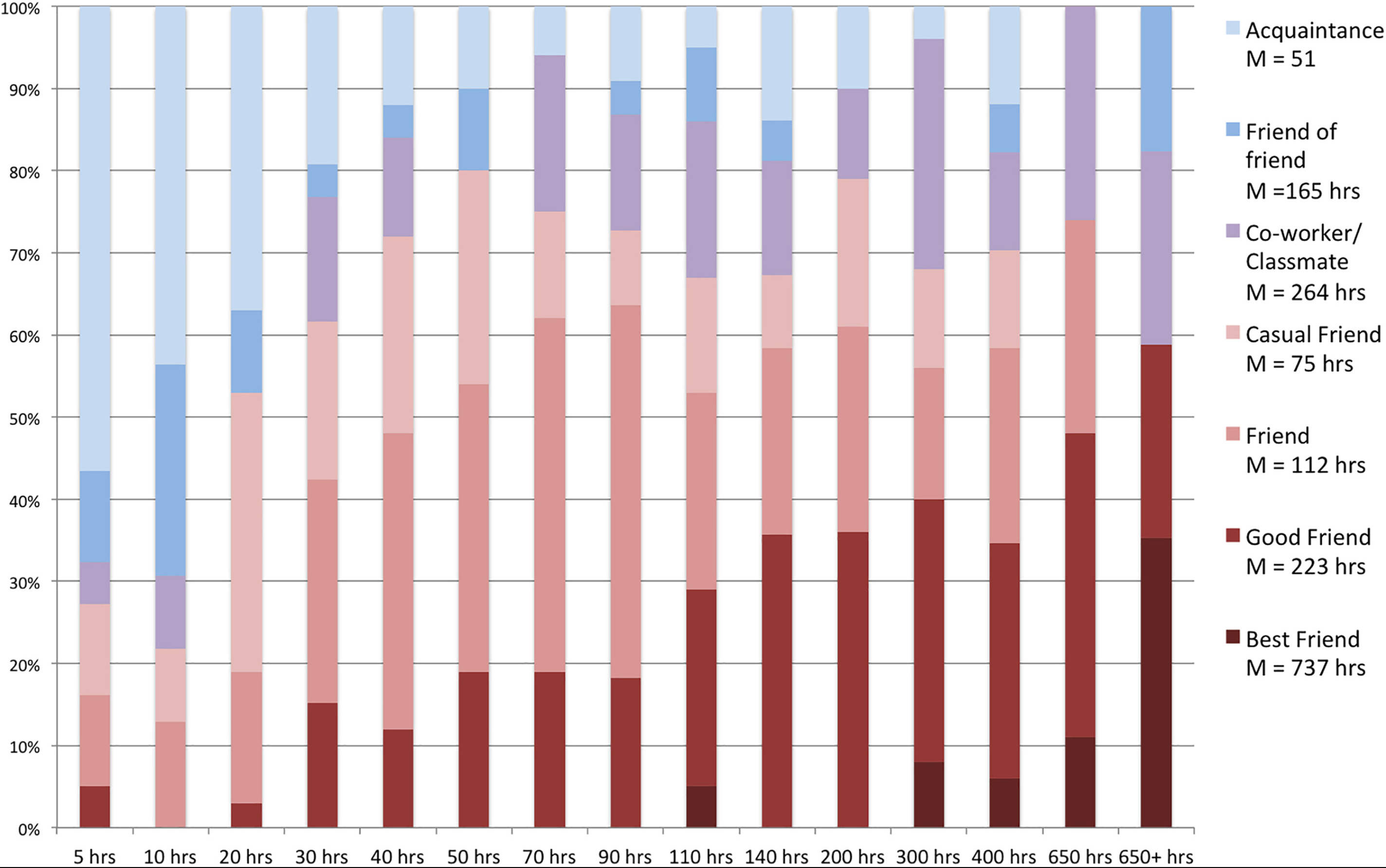
Abstract
The question of this investigation is, how many hours does it take to make a new friend? Drawing from Dunbar’s social brain hypothesis and Communicate Bond Belong theory, friendship status was examined as a function of hours together, shared activities, and everyday talk. In Study 1, MTurk participants (N = 355) who had recently relocated estimated time spent with a new acquaintance. Hours together was associated with closer friendships. Time spent engaging in leisure activities also predicted closeness. In Study 2, first-year students (N = 112) reported the number of hours spent with two new acquaintances three times over 9 weeks. Hours together was associated changes in closeness between waves. Two types of everyday talk predicted changes in closeness.
Russia Takes the Gulag Out of the Gulag History Museum in Moscow
Meanwhile, in Russia, history keeps getting unwritten… (which might be worse than being rewritten tbh)
The Gulag History Museum in Moscow, the last prominent Russian institution dedicated to preserving the memory of Stalin’s labor camps, is being replaced by a new museum focused on Nazi war crimes and the “genocide of the Soviet people,” the city government announced on Friday.
[…]
The museum’s permanent collection included an array of battered cell doors from different camps, and its special exhibitions featured unique memorabilia, like the clandestine diary of camp life drawn as cartoons. Its exposed brick walls, black metal fixtures and dim lighting were meant to evoke the camps.
Museum researchers also carried out research expeditions around the country to gather oral history from those who had survived the camps, and the museum put a special emphasis on documenting the repression of ordinary people.
And here is the spot-on commentary of Novaya Gazeta (translated):
It seems that discussions about the mechanisms of terror - denunciations, ‘enemies of the people’, punitive bureaucracy, closed courts, fear - can all too easily be understood as a reflection of the present. And those who made the decision to close the museum understand this all too well. For those in power, this is toxic: such comparisons sensitise society to today’s arbitrariness and make the language of state propaganda less convincing. It is therefore more advantageous to shift the focus of historical perspective onto issues where the violence comes from outside rather than from within, where the moral line has been drawn in advance and doesn’t require further questions directed at one’s own state.
My Honest Views
Me after two Aperol Spritzi (no idea what the actual plural is; but this sounds right lol).
I probably agree on Dennett, Davidson, Kripke, Husserl, Wittgenstein, and Chomsky. But overall, this is just infantile BS. The discovery of knowledge is dialectical. None of these accusations really matters. One good thought is enough.
This guy should read Scott Alexander’s brilliant “Rule Thinker In, Not Out.”
I think David Lewis was off his rocker, I think Donald Davidson was far too impressed by elementary logic and decision theory, I think Willard Quine was a mediocre logician with some philosophical side-interests, I think Daniel Dennett never understood philosophy, I think Michael Dummett was a dimwit outside of his narrow specializations, I think P.F. Strawson struggled to understand much of philosophy, I think Gilbert Ryle was a classicist who wanted philosophy gone by any means necessary, I think Gareth Evans had no philosophical depth, I think John Searle was too wedded to common sense, I think Jerry Fodor had no idea about philosophy and didn’t care, I think Saul Kripke was a mathematician with a passing interest in certain limited areas of philosophy, I think Hilary Putnam was a scientist-linguist who found philosophy incomprehensible, I think Ludwig Wittgenstein was a philosophical ignoramus too arrogant to learn some history, I think Bertrand Russell was only interested in skepticism, I think Gottlob Frege was a middling mathematician with no other philosophical interests, I think the positivists were well-meaning idiots, I think Edmund Husserl had no interest in anything outside his own consciousness, I think Martin Heidegger and John-Paul Sartre were mainly psychological politicians, I think John Austin was a scientifically illiterate language student, I think Noam Chomsky was neither a professional linguist nor a philosopher nor a psychologist but some sort of uneasy combination, I think the vast majority of current philosophers have no idea what philosophy is about and struggle to come to terms with it, I think philosophy has been a shambles since Descartes, I think Plato and Aristotle were philosophical preschoolers, I think no one has ever really grasped the nature of philosophical problems, I think the human brain is a hotbed of bad philosophy (and that is its great glory).
Peace,
SG