
Links 19.2026

On a Personal Note
Initially, I wanted to say »Jambo!« from Kenya; but that would expose me as a dumbass tourist. So, as a culturally sensitive and hyper-aware (≠ woke) traveler (≠ tourist), I would obviously never do such a thing.
Greetings from Nairobi, nevertheless. I am still on my small little world tour—which will continue in Korea next week. But before that, I’m heading to the Maasai Mara tomorrow morning for a safari. So, in case you drop me an urgent E-Mail over the next couple of days: Good luck! I will be “Out of Office” in the most literal sense.
The tweet of the week is basically a hidden reflection of “nothing-ever-happens”:


Peak Postliberalism
As mentioned in the last newsletter, I recently published a rather well-received and widely shared article on why I tend to think postliberalism has been such an intellectually hollow movement tht it left almost no real mark on liberal discourse.
Obviously, the piece is in German. So I finally ran it through an LLM, made some minor adjustments, and extracted a few of the core ideas below.
But do read the whole thing. And let me know if you want to translate it into your language and publish it elsewhere.
When Polity Press sent me two books on postliberalism for review at the beginning of the year, I was initially somewhat surprised. In a way, time seemed to have caught up with me. Had Adrian Pabst not proclaimed the “post-liberal moment” only in 2020? And surely the publication of Rod Dreher’s The Benedict Option (still, in terms of its impact on this movement, perhaps the most underestimated work) and Patrick Deneen’s Why Liberalism Failed cannot have been that long ago. I could have sworn it was only yesterday.
And yet, while reading Matt Sleat and Paul Kelly, I quickly realized that more time has passed since that summer of 2019, which I spent with these precursors of the much-invoked “vibe shift,” than one might think.
And at the same time, somehow not.
For from today’s perspective, Deneen, Vermeule, and company appear strangely fleeting, transient, and ultimately without consequence. Intellectually, and perhaps soon in real political terms as well, postliberalism has simply... fizzled out.
It is hardly surprising, then, that the odd philosophy professor now appears, just before the curtain falls, to take the measure of postliberalism through taxonomies, conceptual analyses, and intellectual-historical classifications. It reminds me a little of the moment when my barber suddenly asks about Bitcoin again during the next bull run. Or, to put it differently: is this peak postliberalism?
[…]
The more plausible conclusion, then, is this: Kelly and Sleat grant postliberalism more intellectual radiance than it ever had or wanted. Deneen and company were never interested in a systematic critique of ideology or in the further development of a common-good-oriented communitarianism for the present. At the center was always the polemic against the supposed dominance of Rawlsian left liberalism at universities. That is what drove these authors at a deeply personal level. And Orbán’s minions at MCC were primarily concerned with building a politically useful counter-narrative to liberal democracy.
Yet the intellectually productive discourse reconstructed by Sleat and Kelly never actually emerged. There is neither a rising generation of postliberal thinkers nor any recognizable development of the project, nor any serious engagement with postliberalism on the liberal side. This is precisely why postliberalism is hardly suited to being treated as a profound object of study. It appears instead to have been a politically motivated, premature, and intellectually sloppy attempt at revolution, one that sought to anchor the swan song of liberalism above all narratively, that is, metapolitically. But in the end, it was never really taken all that seriously, neither by liberals nor by postliberals themselves.
The Book That Changed How I Think About Liberalism
I know there are things to dislike about Ezra Klein: the quintessential Ezra-splaining, the notorious ambiguity of his positions, and, of course, the disappointment that “abundance” might in the end just mean more technocratic governance.
I share many of these concerns. And yet, I stand by my position that he is the most important liberal (w/ my authority on that matter, I hereby attest that he is, indeed, a liberal) intellectual of our time.
This week, Ezra published an interview with Helena Rosenblatt, author of the here many-times-recommended “Lost History of Liberalism.” Rosenblatt’s work has been a major inspiration for my own thinking and an important source for my essay on the moral aspiration of liberalism.
Ezra opens the interview with a short spiel that is so wonderfully written that I will publish it here in its entirety. He really is an annoyingly (!) gifted writer and orator. I wish I had even 10% of his talent.
Listen to the whole interview, especially if you are not yet familiar with Rosenblatt’s book.
We live in this moment when illiberalism is winning, when illiberalism is in power. I don’t think anybody really argues against that. But what has surprised me is how weak liberalism has felt in response.
I’m a professional liberal — one involved in liberal politics — and even I don’t think I could tell you what liberalism’s vision is, or who its leaders are, at this moment.
In some way, liberalism never really recovered from the Obama era — when it had this grand victory in electing America’s first Black president; when it had this thoughtful, deliberate and, frankly, quite popular liberal leader.
Then it ended in Donald Trump’s being elected — not once but twice. But here’s the thing: Donald Trump is not working out. He is not making people want more of what he is.
If he’s going to be beaten, if illiberal political forces are going to turn back, I think you’re going to need a liberalism that is aspirational again. A liberalism that has moral imagination again. A liberalism that stands for more than “not this.”
So I’ve been on a somewhat esoteric personal quest to read books in the liberal canon, as well as histories of liberalism, to try to think through what exactly in this long tradition is valuable for us right now.
One of the books I came across in this search is “The Lost History of Liberalism” by the historian Helena Rosenblatt. One of the arguments she makes is that for thousands of years before we had the word “liberalism,” there was the tradition of being a liberal. Behind that tradition there was the virtue called liberality, and people thought this virtue was really important.
As Rosenblatt writes, for almost 2,000 years, liberality meant “demonstrating the virtues of a citizen, showing devotion to the common good and respecting the importance of mutual connectedness.”
Liberality was talked about everywhere. You can read about it in Cicero, in John Locke, in the letters of George Washington. And yet we never talk about it today. Liberalism as a political philosophy and movement completely elbowed out liberality as a virtue, as an ethic that citizens aspire to meet.
I want to be clear: I don’t think a rediscovery of liberality is a complete answer to what ails liberalism. But I do think it’s one piece of the puzzle that I found exciting. And I think it’s one place to begin an inquiry that you’re going to hear a lot more about on the show this year.
Presidential Fight Club
In the science corner this week, we look at the opinion-polling culture that is Murica:
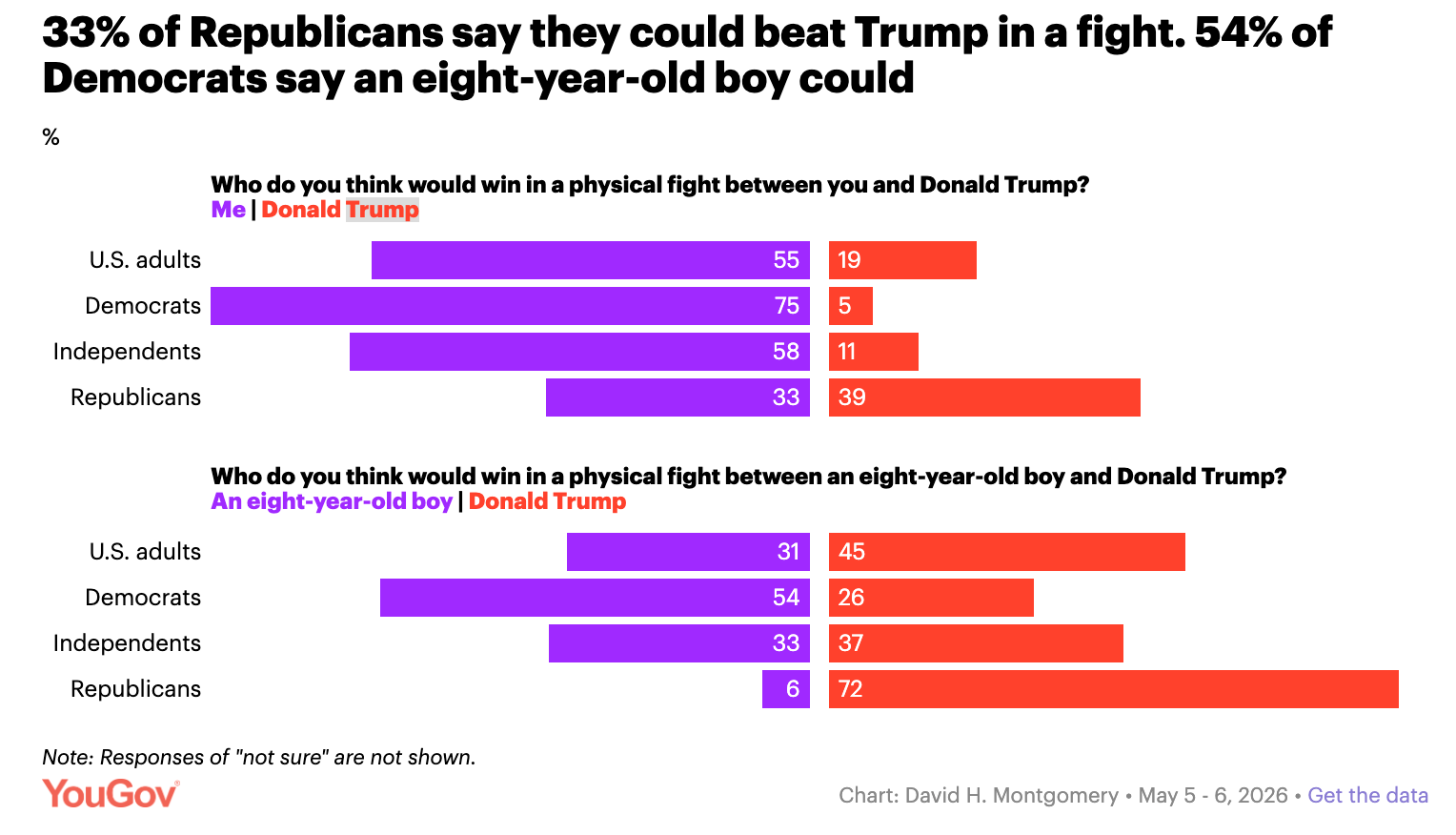
This week, at a White House event about physical fitness, Donald Trump asked a boy, “You think you could take me in a fight?”
We at YouGov thought that was a striking question, and promptly asked 2,609 Americans whether they thought an eight-year-old boy, a typical American, and themselves could win a physical fight with Trump.
66% of U.S. adults say an average American would beat Trump, while 10% say Trump would win. On all three questions, Democrats are far less likely than Republicans to say Trump would win. For example, almost all Democrats say they could win a fight with Trump (75%, while only 5% say Trump would win), but Republicans are slightly more likely to say they’d lose than win (33% vs. 39%).
Democrats are more likely to say an eight-year-old boy could beat Trump than Republicans are to think they could beat Trump (54% vs. 33%).
[…]
YouGov polling has found men are more likely than women to say they would win contests, such as fights with wild animals, tennis points against Serena Williams, and battles with aviation emergencies. That’s true for a hypothetical fight with Trump, too: 64% of men say they could beat Trump, compared to 47% of women.
Why Tech Bros Are Now Obsessed with Taste
Let’s end with a rather half-baked thought—and an attempt at some cultural critique.
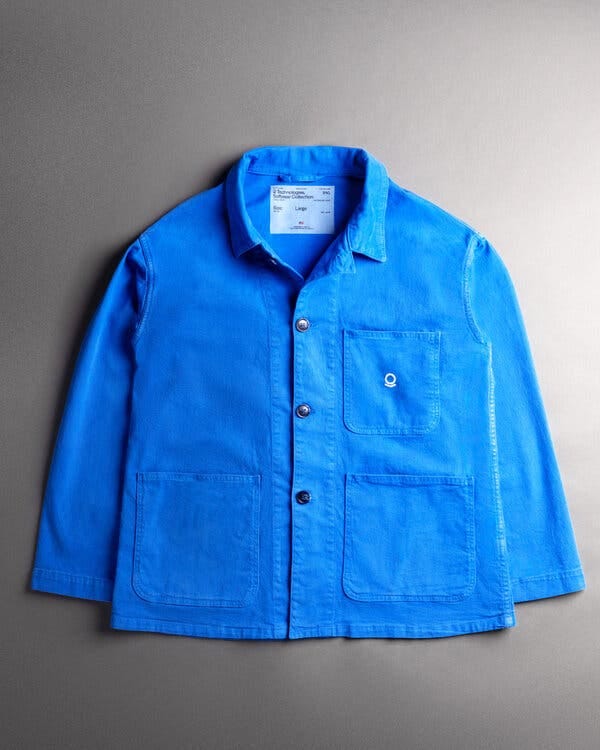
I recently saw that Palantir is selling this very stylish bleu de travail (a blue French worker’s jacket), and I was wondering what exactly the point of that might be. I mean, Palantir is a damn software surveillance company. But then I came across this article, which introduced the term “taste-washing.” And I think the author is onto sth.
Because in a classical Bourdieusian sense, I tend to think that “taste” (or whatever these people mean when they say it) is mostly a feature of elite distinction. Our AI overlords want to create the impression that they are not part of the slop their products generate. They want to appear as men-above-time—Being (!) beyond their creations.
The only problem is that the Elon Musks of this world are simpletons at heart. There is no aristocratic greatness there, no real taste-making ability, no deeper aesthetic or moral merit. Their obsession with taste is just performance. Nothing more.
And that, once again, is truly a sign of our times.
(Maybe more on this in the future, but I feel these few sentences basically capture it all. Martin Gurri and Christopher Lasch knew this all along. It’s not that deep.)
A decade or two ago, millennial hipsters made a claim to good taste by exercising their preference for, say, craft India pale ales over Budweiser, Arcade Fire over Nickelback, or American Apparel over Abercrombie & Fitch. Hipster identity was built on what one chose to consume, and a fetishization of the lo-fi, the handcrafted, and the artisanal—qualities that were eventually co-opted and absorbed by corporate behemoths such as Meta, via Instagram, and Amazon, via Whole Foods. Now A.I. companies are attempting to hitch themselves to a similar aura of artisanality, even as their core products promise to automate all that is human into obsolescence. Last year, Anthropic hosted a pop-up café in Manhattan (what could be more hipster?) and gave away baseball caps embroidered with the word “thinking.” OpenAI’s recent Super Bowl commercial, titled “You Can Just Build Things,” is shot, with faux-analog cinematographic flair, from a human point of view, with hands gripping the handlebars of a bike, writing in a notebook, and playing chess—never mind that the thing being advertised is a hypothetically omniscient robot. You, too, can be tasteful, the ad seems to say, if only you choose the right chatbot to run your life.
A.I. companies need to associate themselves with taste precisely because their tools are not very palatable, much less cool, to anyone outside of Silicon Valley. Many people view A.I. tools as a threat—to their livelihoods, to their futures, to their senses of self. Few, whom I know, see them as individuality-affirming life-style choices. We might call what’s going on now “taste-washing,” an attempt to give anti-humanist technologies a veneer of liberal humanism.
[…]
However discerning the humans behind these endeavors fancy themselves to be, A.I. remains a fundamentally tasteless technology, in at least one respect. The eighteenth-century French philosophers who established a definition of taste in Western thought considered it an ineffable quality, a reminder that the God-given goodness in each of us recognizes that of the rest of the world. Voltaire once wrote that, “in order to have taste, it is not enough to see and to know what is beautiful in a given work. One must feel beauty and be moved by it.” No large language model has yet been programmed to feel anything, and no number of branded baseball caps is going to change that.
Peace,
SG