
Links 11.2026

On a Personal Note
I just landed in Vilnius after a few days in beautiful Lisbon. Although I have to say, the topography of that city is a major turn off—because it makes a casual stroll almost impossible. I mean, I don’t want to go on a hike every time I’m up for a bar or restaurant. And those cobblestones make you regret taking a taxi every single time. My goodness. Other than that, great city :P
Not much more to say for the moment. Some big news coming soon.
Meanwhile, I’m opening ice cream season. As we all know, my Pistachio-Ice-Cream-Theory™ will finally go viral this summer, I promise. And for lack of better alternatives, I’m kicking things off with the dumbest tweet imaginable.
I did laugh, though.

An Extremist Walks into a Sauna
Okay, here we have the coverage of a somewhat remarkable episode: The self-proclaimed liberal democratic intellectual elites of Elmau encounter the infamous NRx figure Curtis Yarvin aka Mencius Moldbug. And you kiiiinda can imagine how that goes lmao
Ofc, my long-time readers know Yarvin way too well. I have been writing about him since 2018, after all; but that was still when he wrote under his alias. I believe it was ultimately this portrait that made him known to a wider public. In any case, I suspect that very few (read: none) of those attending Elmau have systematically read Yarvin.
So, to bring you up to speed: From my perspective, Yarvin is what your traditional Bildungsbürger (like the archetypal New Yorker reader) imagines the New Right to be. Because Yarvin is good at two things: (a) coining terms, like “The Cathedral” (where intellectual elites manufacture consent) or the idea of the CEO-monarchy; and (b) ragebait. Unlike other post-liberal or illiberal figures, his provocations are usually characterized by the absence of any real attempt to develop a substantive argument. Instead (and I do recommend trying to read him), he hides behind an annoyingly convoluted, constantly rambling, and often esoteric prose. Much of it reads like those self-help non-fiction books that say a lot of things without ever quite saying anything.
But okay, personal taste aside, they invited him to Elmau. And what happened there sounds entertaining and somewhat uncanny. I mean, he apparently bonded with… Alex Soros, of all people lol. Moreover, you get the usual drama like the essential performative outrage from people like Leah Ypi or Quinn Slobodian (of course, if it were their Marxist friends once again relativizing the Soviet Union, they would happily moderate the session instead of dropping out), plus some peak boomer-ism of Ivan Krastev, who doesn’t know how to handle the dynamics of cancel culture.
Plenty of hilarious anecdotes. Worth a read. Though like much of Die Zeit‘s journalism, the author often made me sigh and think, “It’s not that deep, brother.”
One final remark: Joking aside, I actually welcome these kinds of intellectual encounters. Not only because I’m a fan of debate and free expression; but because I genuinely believe that a lot of political polarization is basically sociology. Put these people in the same room, and they often realize they are not that far apart.
Maybe that’s the Straussian reading of this whole article.
For five days, various intellectuals were scheduled to gather at the five-star hotel Schloss Elmau in the Alpine foothills of southern Bavaria to discuss the world. Such was the vision of the brilliant political scientist Ivan Krastev. But of course, the entire labyrinthine chamber play got going even before the conference started. Two days prior to arrival, my phone rings – a participant is on the line. I had asked her that morning what she thinks of Yarvin, and now, she is calling to say that she has just discovered a tweet of his that reads: “Hitler was a genius.” How is she supposed to stand being in a room with someone like that, she wants to know? She says she is going to call Ivan Krastev, who chose the participants, whereupon Krastev then confronts Yarvin. Yarvin then assures him that he had meant Hitler as an “evil genius” and promises to explain himself to the symposium’s participants at Elmau.
Even during the preceding weeks, left-leaning intellectuals such as Lea Ypi and Quinn Slobodian had been taken to task on social media for agreeing to participate in the symposium alongside the “openly fascist speaker.” Both withdrew.
[…]
“Coming up next: the Thrilla in Manila,” the moderator announces before dinner, referring to the conversation between Krastev and Yarvin, a nod to the legendary 1975 boxing match between Muhammad Ali and Joe Frazier. Yarvin has just spent the entire afternoon in the tea salon drinking red wine with a New York Times journalist. When the audience now begins laughing, he jolts to attention and hastily joins the applause. It looked as though he may have dozed off. At dinner, he sits with the EU-skeptic historian Yuri Slezkine, who is also something of an outsider, and two journalists; together they empty three bottles of red wine alongside duck breast braised to a rosy pink. Yarvin orders two more glasses of Macallan Scotch on the journalists’ tab at nearly 50 euros a glass. Then it is time for the fight. [SG: That guy can drink]
The hall is packed. Many people stand up and take photos, as if a pop star were sitting up front in a herringbone blazer, jeans and disheveled black hair. The lights go down; proprietor Dietmar Mueller-Elmau introduces Yarvin: “He is considered a leading thinker of, how shall I put it, the authoritarians in America.” Krastev then explains why he invited Yarvin in the first place. It is no longer enough to simply ask: “How can we defend democracy.” In the face of Yarvin’s ideas and those of his followers, he says, we must ask a different question: “Is democracy worth defending?” An interesting maneuver. But Yarvin evades the question. Not with Muhammad Ali-like quickness, though. Instead, he circles around his own attacks on democracy for so long that Krastev knocks out the monologue with a single line: “You don’t like the word.”
The audience, professors from Oxford and Cambridge, the international press – including the influential German-Jewish journalist Rachel Salamander – all frown toward the stage. Peter Sloterdijk’s mustache quivers up and down. “All power comes from God,” says Yarvin. He says he finds many of the institutions he criticizes to be wonderful once he actually visits them. Might someone be knocking himself out at the moment? Krastev asks who would guarantee freedom in his CEO monarchy. “Great question,” Yarvin praises. And launches into a response, seemingly unclear about where it is headed. Yarvin invokes Franklin Roosevelt, the powerful president of the 1930s and 1940s, and then says the U.S. has always been a sham democracy. Fair enough, but what is he fighting against then, if presidents are essentially CEOs anyway? He twists and turns so awkwardly that it almost sounds as though he wants a more genuine democracy. Or is Yarvin merely performing the role of the disillusioned liberal? Yarvin seems scattered. He makes dubious quips: “The public is like a woman,” you shouldn’t push it around. Yarvin lets out a belch while speaking. Where is the destruction-hungry provocateur? Where is the inhuman Silicon Valley efficiency? Where is the offensive arrogance? Krastev wraps up the conversation after barely an hour. The audience applauds politely.
Jürgen Habermas Dies at 96; One of Postwar Germany’s Most Influential Thinkers
Jürgen Habermas, a philosopher and public intellectual who was one of the most influential and cited thinkers in postwar Germany, died on Saturday in Starnberg, Germany, southwest of Munich. He was 96.
Unlike apparently most of German twitter, I have never had a personal encounter with Habermas. In fact, I should admit that I have only read some basic Habermas. And when I did, I was not particularly impressed. I suspect that my very Anglo-Saxon training in philosophy beat all the innate Jerman patience out of me. I simply cannot bring myself anymore to wade through the almost endless pages of surely eloquent, but way too often way too unsystematic, prose that comes with critical theory and Habermas. And I feel it’s okay to recognize that.
Naturally, I also checked which articles about Habermas I had shared over the last 8+ years of this newsletter. Turns out there were some interesting ones:
I think if you read those two, you can more or less infer what my view of Habermas has been. The latter one in particular seems worth revisiting. This sentence seems very timely indeed:
Outraged Chinese intellectuals such as Zhang Rulun countered that by supporting the violation of Serbian sovereignty, Habermas was more like Schmitt than he realized. Zhang argued that Habermas had revealed Western liberals, for all their talk of “democratic procedure” and “dialogue,” had no more respect for international law than the “rogue” states they wanted to bomb.
Because as much as Habermas shaped important debates in ideal theory and coined crucial concepts (i.e., der zwanglose Zwang des besseren Arguments), he represents to me most of all a nostalgic artifact of the long-gone Germany of the Bonn Republic—something reflected in his deeply confused approach to Eastern Europe, Ukraine, Israel/Gaza, and foreign policy more broadly. That made him also a perfect fit for the German Social Democrats.
With his death, Germany is quite literally turning a page. Some might say it is about time…
Here are a few passages from the essay mentioned above. Uncannily relevant today:
More troublingly, Schmitt has become a major point of reference for leaders of the rising global power. China’s use of Schmittian theory to justify its recent crackdown in Hong Kong has been widely noted, but, as Gloria Davies warned in her 2007 article “Habermas in China,” if Schmitt has taken off in China, this is in part Habermas’s fault. Widely read in the 1990s and early 2000s by reform-minded intellectuals, Habermas sparked outrage when he seemed to violate his own cosmopolitan liberal theory by endorsing NATO’s bombing of Serbia, which infamously destroyed China’s embassy in Belgrade.
Habermas’s most widely read article in favor of airstrikes against Serbia, “Bestiality and Humanity,” was structured by claims that Slobodan Milosevic’s regime was committing crimes against humanity—and by an attack on Schmitt, who had dismissed the idea of crimes against humanity with the phrase, “humanity, bestiality.” Outraged Chinese intellectuals such as Zhang Rulun countered that by supporting the violation of Serbian sovereignty, Habermas was more like Schmitt than he realized. Zhang argued that Habermas had revealed Western liberals, for all their talk of “democratic procedure” and “dialogue,” had no more respect for international law than the “rogue” states they wanted to bomb.
Zhang has revealed a fact about Habermas he has often been at pains to conceal, if not escape: That behind his liberal veneer is an emotional and ultimately irrational heart. But what afflicts Habermas is less hypocrisy than self-denial—a lack of self-knowledge that has made it impossible to avoid a drift toward political irrelevance. What remains to be seen is whether the same is true of Western political culture writ large.
The Trouble with Hegemony: Hegemonic Destabilization Theory
Some people are ahead of the curve…and then there is this guy, writing about “hegemonic destabilization” back in 2003 (!). Interesting throughout!
Maybe 9/11 was more consequential than the Great Financial Crisis after all. Probably a question for Tyler Cowen.
Abstract
This paper revisits hegemonic stability theory to examine whether hegemony, in terms of its major justifications, applies to the United States in the present period. The paper finds that over time, particularly since the end of the Cold War, the role of the United States has increasingly changed from hegemonic stabilization to destabilization. While hegemonic destabilization such as the unleashing of finance capital and military preparedness out of proportion to existing threats, has been noticeable since the Reagan period, recent American policies of aggressive unilateralism and deficit spending have been increasingly destabilizing. This holds implications for how we understand hegemony: should we replace hegemonic stability theory with a theory of hegemonic destabilization? If hegemonic stability made for a “relatively open and stable” global economy, what kind of world does hegemonic destabilization create? This raises the question of hegemonic transition and the configurations emerging as hegemony unravels.
Realignment & Baden-Württemberg
This is a short follow-up to last week’s election review of Baden-Württemberg. When I wrote my Wahlnachlese, the full election data were not yet available. Now that we have them, I wanted to share one pattern that once again lines up almost perfectly with our Great Realignment hypothesis. Recall this variation of Steve Davies’s initial compass:
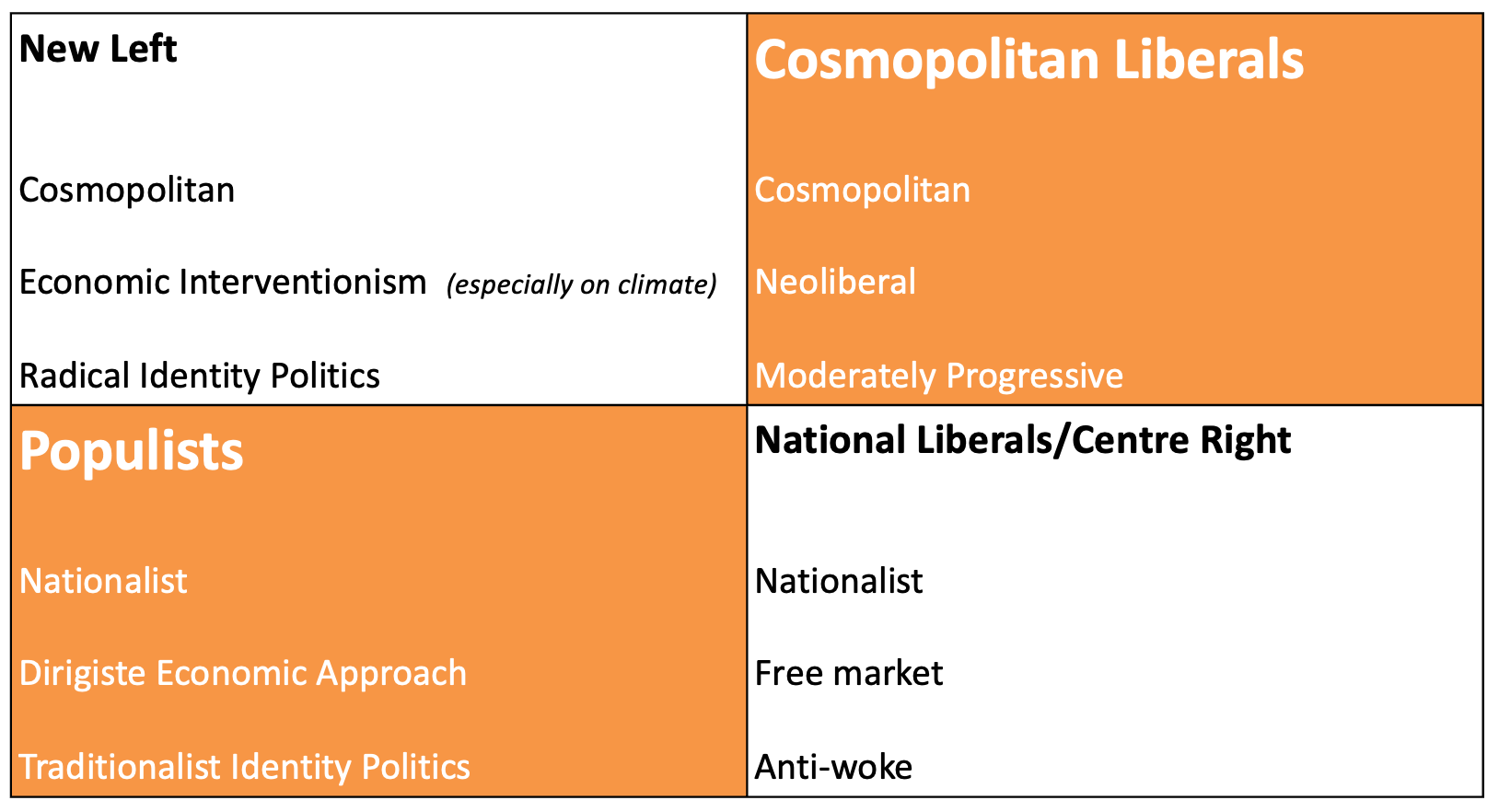
Unlike Eastern Germany, Western Germany is still in the middle of this broader realignment process. In several states, including Baden-Württemberg, the center-left and center-right parties are still heading for head-to-head races. As explained in last week’s newsletter, we had a peculiarly tight race this time—where the dynamic of not knowing who was about to win squeezed out the fringes.
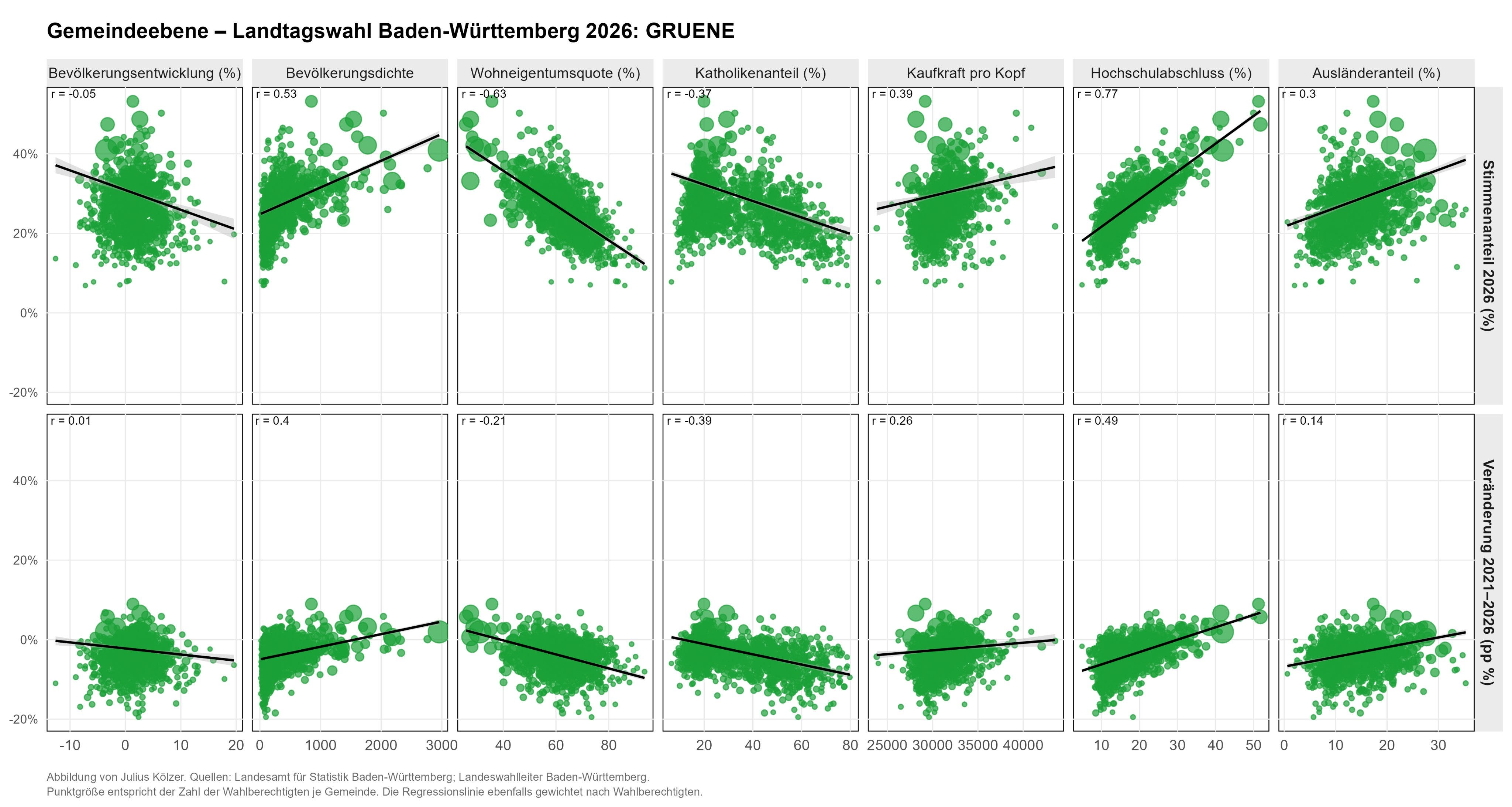
In hindsight, we now see clear quadrants emerging. For example, the Greens absorbed most of the cosmopolitan liberal milieu. Their electorate almost picture-perfectly matches what you would expect from this quadrant:
=> young, urban, elites (education & material conditions), often female
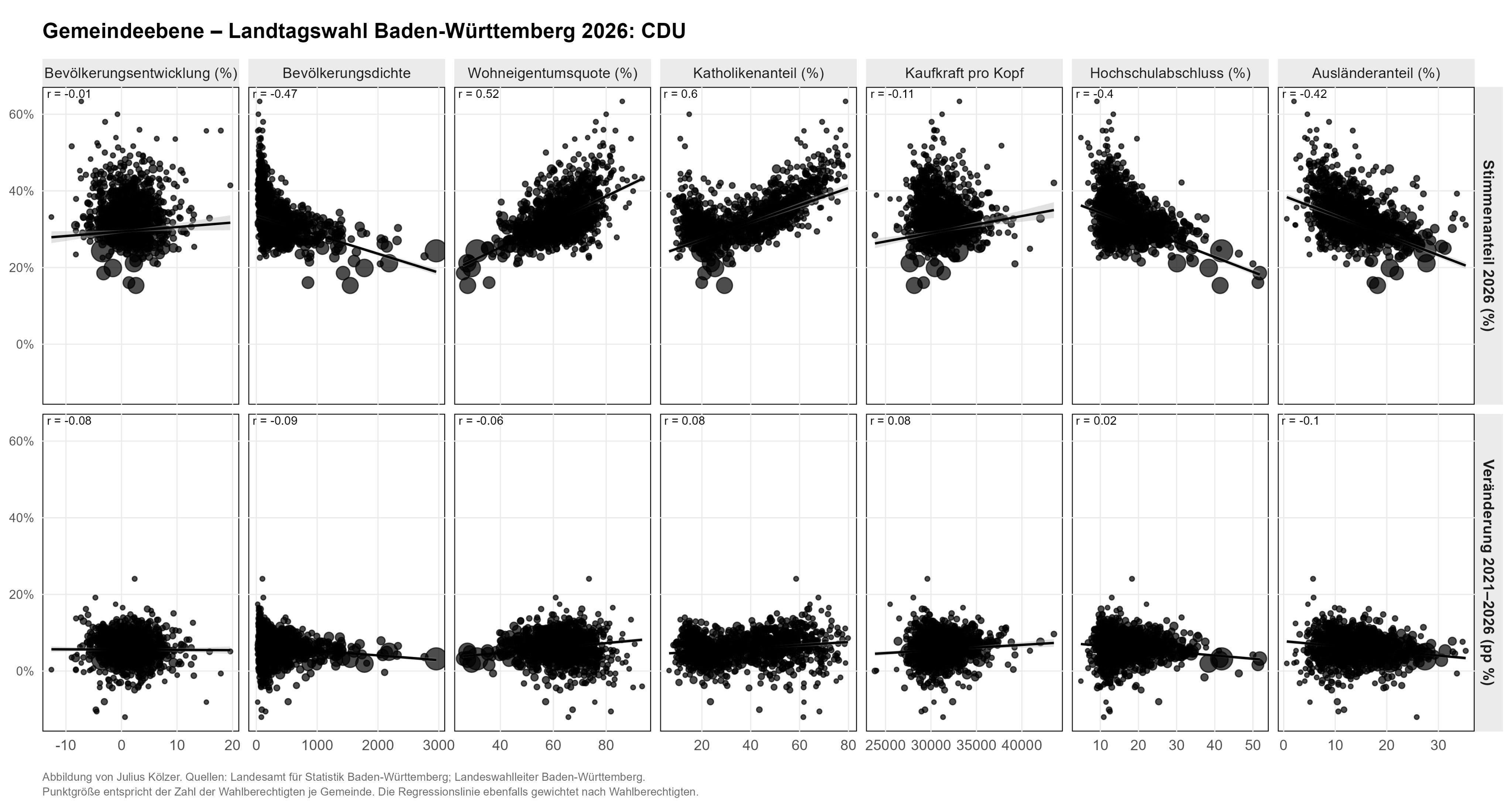
On the other side, the CDU operated as the center-right, national-liberal big tent alternative (effectively absorbing much of the traditional FDP vote as well):
=> rural, lower levels of formal education, rather middle class, and often male.
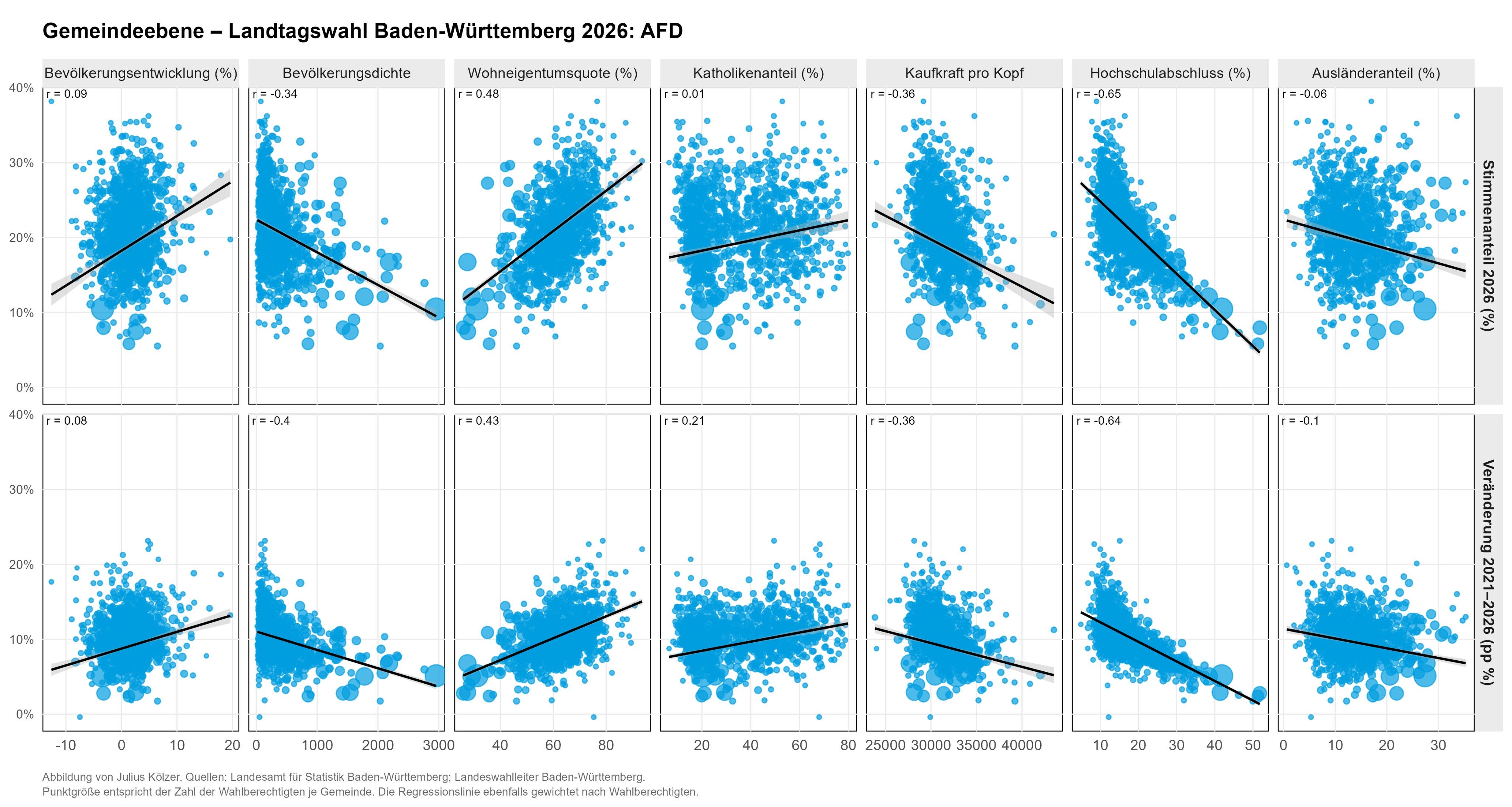
Lastly, the AfD (i.e., our neighborhood populist party) occupied its own relatively independent quadrant. Unsurprisingly, they performed particularly strongly among voters with low levels of formal education and became the working class's primary political choice. They were also not really affected by the tight race of the centrist candidates, as they mainly gained from previous non-voters.
Peace,
SG